
 Start here
Trauma AcademyResearch & Discussion

The research desk
The evidence.
The conversation.
One-page pocket guides and selected recent papers. Explore key decisions, examine the evidence and bring better questions to your next clinical discussion.
Updated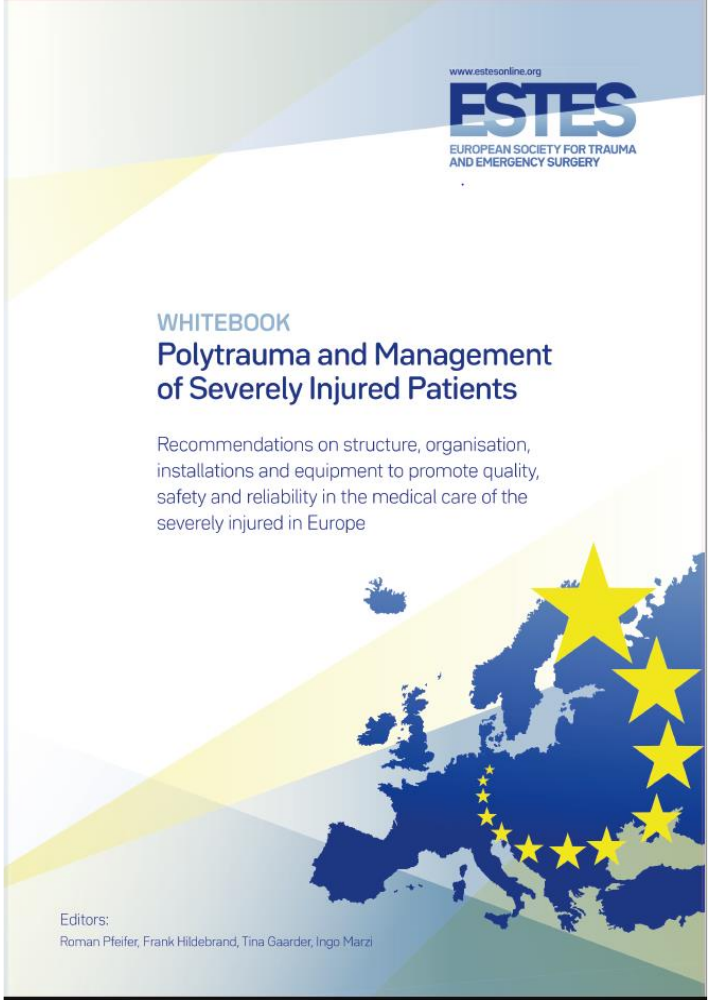
Featured publication · ESTES · 2025
The European
White Book.
Polytrauma and Management of Severely Injured Patients
A shared framework for trauma systems, education and care from prevention to rehabilitation.
Edited by Roman Pfeifer, Frank Hildebrand, Tina Gaarder and Ingo Marzi.
Research & discussion / Pocket guides
Key decisions.
One page at a time.
36 concise guides for trauma teams. Read, download or print for your next teaching session.
Browse all 36 guides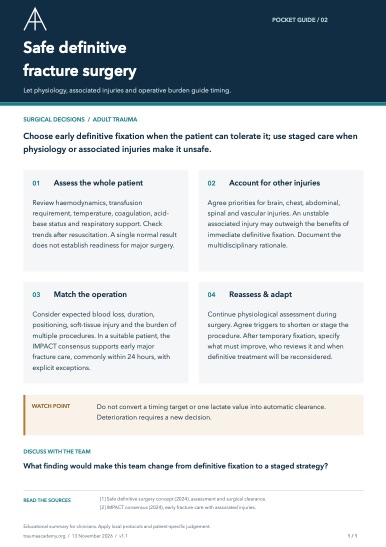
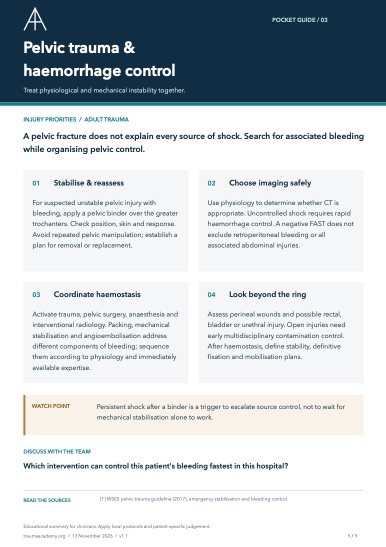
Adult trauma education · Source-linked · Updated 13 November 2026
Download all 36 guidesRead and discuss
Recent paper discussions.
6 articles · Selected recent publications
Systematic review of management algorithms
Pelvic trauma algorithms: shared principles, local decisions
What 25 published pathways have in common—and why agreement is not the same as proof of effectiveness.
European Journal of Orthopaedic Surgery & Traumatology
Full-text review
Read the discussionSystematic review & meta-analysis
Fix, replace, or combine?
Weighing early operative burden against later reconstruction in geriatric acetabular fractures.
Injury
Publisher text reviewed
Read the discussionRetrospective single-centre cohort
The Parkland pathway: the system behind the algorithm
Selective angioembolisation, definitive fixation and the importance of local resources.
Injury
Abstract-based review
Read the discussionRetrospective multicentre study
What shapes fracture healing after polytrauma?
Injury severity, surgical timing and the challenge of separating association from cause.
Journal of Clinical Orthopaedics and Trauma
Source-linked discussion
Read the discussionPropensity-matched database study
Knee replacement after a tibial plateau fracture
Why the history of injury matters when comparing conversion and primary arthroplasty.
The Journal of Arthroplasty
Source-linked discussion
Read the discussionProspective comparative study
Pelvic fixation: technique or timing?
A small prospective comparison raises two questions that cannot easily be separated.
BMC Surgery
Source-linked discussion
Read the discussionNo articles match this search. Try another term or choose All topics.
Read the study, then join the conversation. Each briefing identifies the publication, the material consulted and a limitation. These are educational discussions, not individual treatment recommendations. This is a dated selection, not a live literature feed.