
Pelvic trauma algorithms: shared principles, local decisions
What 25 published pathways have in common—and why agreement is not the same as proof of effectiveness.
Read the discussionESTES White Book · 2025
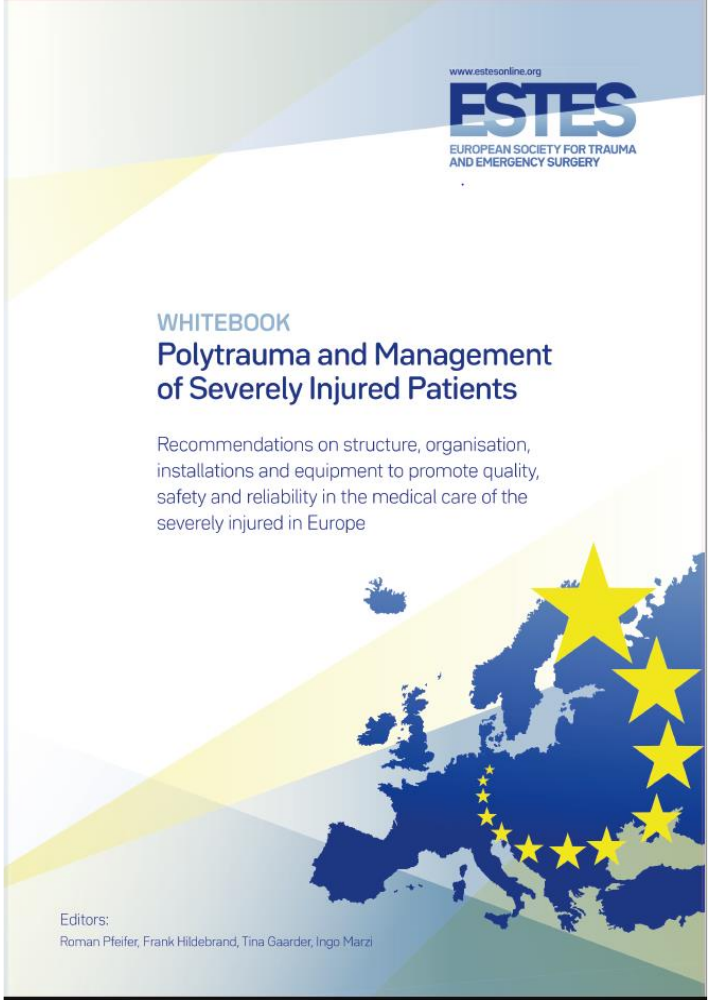
Polytrauma and Management of Severely Injured Patients
Recommendations for the organisation and resources of trauma care across Europe.
58 pages · ISBN 978-3-200-10679-6
Editors: Roman Pfeifer, Frank Hildebrand, Tina Gaarder and Ingo Marzi.
The Academy discussion
A discussion of the 2025 publication, its educational value and its practical limits.
The White Book brings prevention, hospital networks, prehospital care, acute treatment and rehabilitation into one account of the injured patient’s journey. Its organising question is whether a system has the people, facilities and connections needed to deliver care reliably. This makes it useful reading for clinicians, educators and service leaders.
Its European framework recognises that staffing models, geography and resources differ. The accompanying editorial argues for shared requirements with room for local adaptation. That distinction matters: a common ambition does not mean that every hospital must provide the same services.
Read the introductory editorialThe education chapter joins surgical knowledge with leadership, communication, simulation and learning from the patient pathway. Courses sit within continuing professional development. For Trauma Academy, this offers a useful discussion point: how can case-based teaching help a team recognise a problem, rehearse a response and review what happened in practice?
Read the education chapterThe quality-improvement chapter distinguishes structure, process and outcome. Having equipment or a registry does not by itself demonstrate good care. It also calls attention to the limits of hospital mortality as a sole measure: disability, recovery and social reintegration extend beyond discharge. A local review should therefore ask both whether a process changed and whether patients experienced a meaningful benefit.
Read the quality-improvement chapterThis is a collection of recommendations and reviews, not one comparative trial with a single effect estimate. It should not be read as proof that every proposed organisational measure independently improves outcomes, or as binding regulation. Our interpretation is to use it as a starting point for local gap analysis, then check individual recommendations, national requirements and more recent evidence.
For your next team meeting
Choose one gap in your patient pathway. Who will lead the change, what resources will it need, and which patient-centred outcome will show whether it helped?